






.webp?width=1080&height=1080&name=benefits%20(1).webp)












.webp?width=300&height=300&name=Auto%20Dealerships%20(1).webp)






.webp?width=130&height=130&name=accountant%20icon%20(1).webp)


.webp?width=300&height=300&name=Website%20Image%20(8).webp)
.png?width=1080&height=1080&name=support%20(2).png)









A non-discretionary bonus is a bonus your employees know about in advance and that you are obligated to pay once they meet the stated conditions, such as a sales commission or a promised attendance bonus. Because it is promised rather than given at your discretion, federal law requires you to include it in the regular rate of pay when you calculate overtime for nonexempt employees.
That last part is where most businesses get caught. The label you put on a bonus does not decide how it is treated, the promise behind it does. Here is how the two bonus types differ, what each one does to your overtime math, and how bonuses are taxed.
Key Takeaways from this Article
- A non-discretionary bonus is promised in advance and owed once the employee meets the conditions, while a discretionary bonus is a surprise you were never obligated to pay.
- Non-discretionary bonuses must be included in the regular rate of pay when calculating overtime for nonexempt employees under the Fair Labor Standards Act.
- Calling a bonus discretionary in your handbook does not make it discretionary if your employees were told they would earn it by hitting a target.
- Sales commissions, attendance bonuses, and promised performance bonuses are all non-discretionary.
- Both bonus types are supplemental wages for tax purposes, so the classification changes your overtime calculation, not whether the bonus is taxable.
What is a Non-Discretionary Bonus?
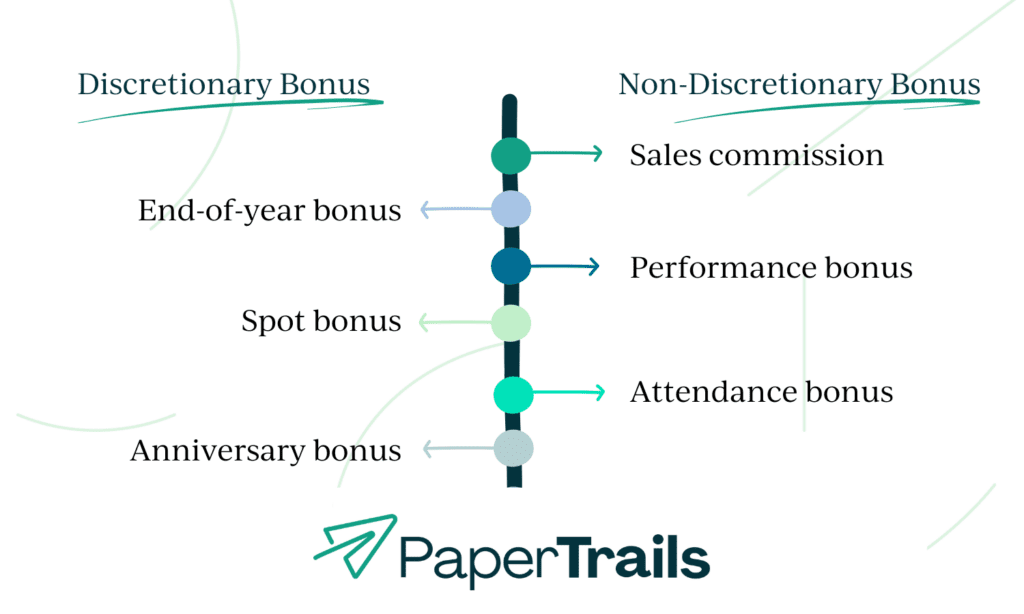
A non-discretionary bonus is additional pay an employer promises in advance and must pay once the employee meets defined conditions. The conditions are usually tied to performance, production, attendance, or a sales target, and they are set out in an employment agreement, a commission plan, or a written policy before the work is done.
The defining feature is the promise. If your employees can predict the bonus because you told them what earns it, it is non-discretionary, whatever you call it internally.

What is the Difference Between a Discretionary and Non-Discretionary Bonus?
The two differ on four things: whether you announced it, whether you owe it, whether it changes your overtime rate, and whether the employee could see it coming.
| Feature | Discretionary | Non-discretionary |
|---|---|---|
| Announced in advance | No | Yes |
| Employer obligated to pay | No | Yes, once conditions are met |
| Included in overtime rate | No | Yes |
| Employee expects it | No | Yes |
| Typical example | Surprise holiday bonus | Sales commission |
The overtime row is the one that costs money if you get it wrong.
Discretionary Bonus Examples
- A surprise end of year bonus, where the amount changes annually and was never announced ahead of time.
- A spot bonus for someone who carried a difficult project, decided after the fact with no pre-set criteria.
- A work anniversary gift that is not promised or repeated on a schedule.
Non-Discretionary Bonus Examples
- A sales commission paid as a set percentage of what the employee sells.
- A year end bonus tied to performance goals you published in January.
- An attendance bonus promised to anyone with no unscheduled absences in a quarter.
- A production or piece rate bonus for hitting an output target.
How Does a Non-Discretionary Bonus Affect Overtime Pay?
For nonexempt employees, a non-discretionary bonus raises the regular rate of pay, which raises the overtime rate along with it. The Fair Labor Standards Act treats the bonus as part of what the employee earned for that work, so it cannot sit outside the overtime calculation.
Picture a shop with a $200 quarterly attendance bonus. One of your technicians earns $20 an hour and works 45 hours in a week during that quarter. You cannot pay overtime on $20. The bonus has to be spread across the hours it was earned over, which lifts the regular rate slightly, and the five overtime hours are then paid at one and a half times that higher rate. Skip that step and you have underpaid overtime on every check in the bonus period.
A discretionary bonus does not do this. That is the practical reason the distinction matters, and it is why a handbook that calls a promised bonus discretionary will not protect you in a wage claim. If the employee could have predicted the bonus, expect it to be treated as non-discretionary.
The math gets more involved when someone works two rates in the same week, which is the same problem as calculating blended overtime.
How are Bonuses Taxed?
Both types are treated the same way here. Bonuses are supplemental wages, subject to federal income tax withholding, Social Security and Medicare, federal and state unemployment tax, and state income tax where it applies. Nothing about calling a bonus discretionary makes it tax free.
You have two withholding options. The percentage method applies a flat supplemental rate to the bonus on its own. The aggregate method combines the bonus with the employee's regular wages for that period and withholds on the total as if it were one paycheck, which usually withholds more up front. Either way the employee's actual tax liability is settled when they file, so the choice affects timing rather than what they ultimately owe. For more on running the payroll itself, see our guide on how to handle a bonus payroll, and the Department of Labor's fact sheet on bonuses for the overtime rules in full.
How Can Paper Trails Help?
Bonus programs are a good way to reward the people who move your business forward. The compliance risk is not the bonus itself, it is the overtime recalculation that has to follow it, and that is the step we see missed most often.
At Paper Trails, we run payroll and tax services on the isolved platform, which handles the regular rate recalculation when a non-discretionary bonus lands in a pay period so your overtime is right the first time. Our team is in Kennebunk, and we are glad to look at your bonus policy before the next payroll rather than after. You can also see exactly what payroll costs on our pricing page.
Updated: September 2026
Written by: Jon Portanova

Is Your Payroll Situation Less than Perfect?
We’ll stay in the weeds to manage your payroll, Human Resources, and compliance needs.